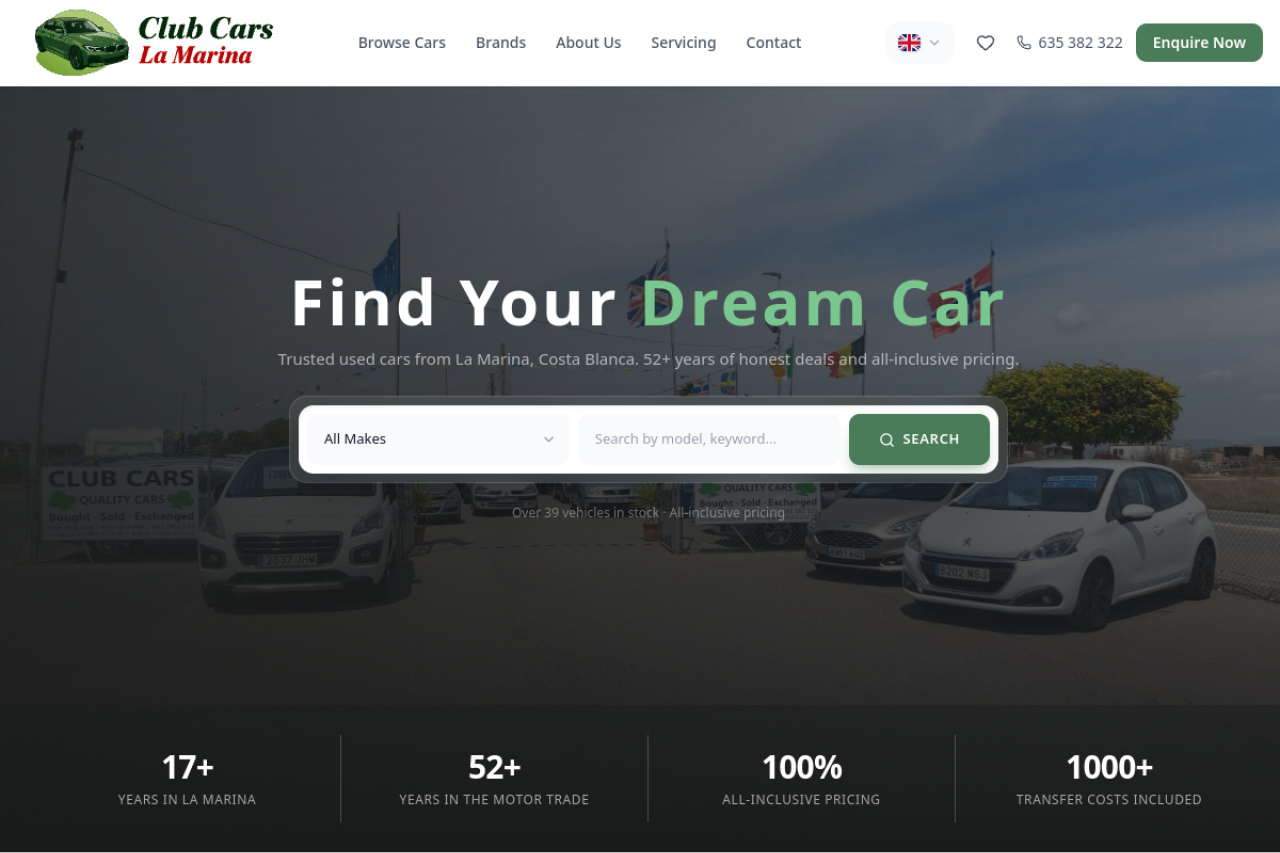
Some businesses earn trust over decades and then undersell it online. Club Cars — a used-car dealership in La Marina on the Costa Blanca, with 17+ years in the village and 52+ years in the motor trade — is the opposite case: a reputation built on honest deals and all-inclusive pricing, now matched by a digital showroom that works as hard as the forecourt.
Club Cars is a case study in what a dealership website should do: show live stock, make search instant, and make pricing transparent.
The problem: forecourt trust, website doubt
Buying a used car on the Costa Blanca is disproportionately an expat transaction. Buyers are often navigating a foreign registration system, in a second language, with real anxiety about hidden costs — transfer fees, taxes, paperwork. A dealership site that hides stock behind a phone call, or prices cars before fees, loses those buyers before they visit.
Club Cars' answer is structural transparency:
- All-inclusive pricing — every price includes transfer costs. The number on the screen is the number at signing.
- Live stock, searchable — 39+ vehicles with make/model search, not a static gallery.
- Trust signals up front — years in the trade, transfer costs included, and 1000+ transfers handled, stated on the homepage.
What the site does well
Instant stock search. A make dropdown covering 12 manufacturers (BMW to Toyota) plus free-text model search sits directly under the hero. One search box, zero friction — the single highest-value interaction on any dealership site.
Brand pages. Each manufacturer gets a browsable landing page, which doubles as an SEO asset: searches like "used Toyota La Marina" land on a focused, crawlable page rather than a generic stock list.
Per-vehicle detail pages. Every car gets its own page with a full photo gallery (11–13 photos per vehicle), year, mileage, fuel, gearbox, and price — the complete information a buyer needs to shortlist before visiting.
Favourites and enquire-now paths. Buyers can save cars and enquire in one tap, with click-to-call wired throughout for mobile users standing on the forecourt — or on a competitor's.
Bilingual by necessity. Serving an international buyer base on the Costa Blanca means language switching (English/Spanish flags) is a core feature, not a footer link.
The engineering behind a dealership site
Dealership websites look simple and fail in predictable ways. The hard parts Club Cars gets right:
- Rotating inventory — stock turns over constantly, so the catalogue must be trivially easy for staff to update, with sold vehicles disappearing immediately. Nothing erodes trust like enquiring about a car that sold last month.
- Image weight — a dozen photos per car across 39+ vehicles is a performance liability. Responsive images and lazy loading keep listing pages fast on mobile, where most buyers browse.
- Structured data — per-vehicle pages with consistent make/model/year/mileage/price markup are exactly what Google needs for rich results and what AI search needs to recommend the right car.
- Conversion paths — every page answers "what next?" with enquire, call, or favourite. No dead ends.
The outcome
A forecourt reputation, digitised: live searchable stock, transparent pricing, and enquiry flows that turn browsers into visitors. For a dealership where each sale is a high-value, high-trust transaction, the website's job isn't to sell the car — it's to earn the visit. This one does.
Visit the live site at clubcars.co, or see the full case study in my portfolio.
Related reading: