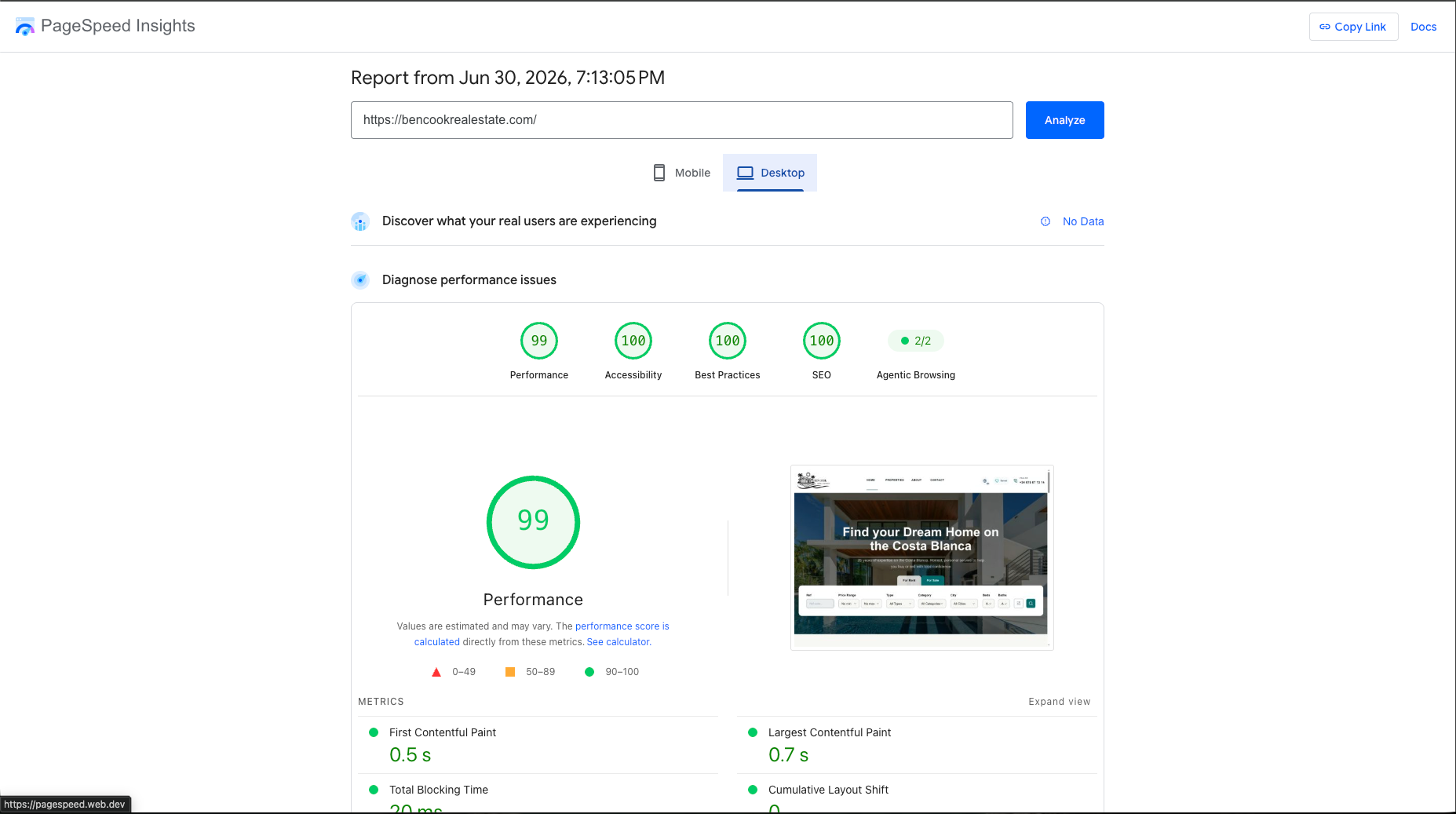
A near-perfect PageSpeed score isn't luck — it's engineering. Here's the exact checklist behind bencookrealestate.com, which scores 99/100 on desktop and 92/100 on mobile, with Accessibility, Best Practices, and SEO all at 100/100.
What Is Google PageSpeed Insights — And Why Should You Care?
If you've ever Googled a local agent and wondered why a competitor's listing site ranks higher despite looking worse, PageSpeed Insights (PSI) might be the answer you haven't checked yet.
Google PageSpeed Insights is a free tool that analyses any URL and scores it from 0 to 100 across four categories: Performance, Accessibility, Best Practices, and SEO. The Performance score is the headline number — and it's one of Google's confirmed ranking signals.
For real estate websites specifically, this matters more than most industries. Listing pages are image-heavy by nature, buyers are often browsing on mobile while out and about, and every extra second of load time is a chance for someone to bounce back to Zillow or Realtor.com instead. Google's own research found that as page load time increases from 1 to 3 seconds, the probability of a mobile visitor bouncing increases by 32%. At 5 seconds, that figure jumps to 90%.
If you're spending money on Google Ads to drive buyer or seller leads, sending that traffic to a slow listing site is like pouring water into a leaky bucket.
What Does "99 on PageSpeed" Actually Mean?
A score in the high 90s puts a website in the top percentile of performance on the web. It means:
- Largest Contentful Paint (LCP) — how quickly the main content (often a hero property photo) appears — is under 2.5 seconds.
- Interaction to Next Paint (INP) — how fast the page responds to clicks, like opening a listing gallery — is near-instant.
- Cumulative Layout Shift (CLS) — how much the page "jumps around" while loading — is virtually zero.
- The site is fully accessible, follows web standards, and is crawlable by search engines.
These metrics form Google's Core Web Vitals, and they feed directly into search ranking — which matters a lot when you're competing for "real estate agent [city]" searches against national portals with much bigger marketing budgets.
When building bencookrealestate.com, performance was treated as a core deliverable from day one, not an afterthought bolted on before launch.
The Exact Stack
SvelteKit
The site is built on SvelteKit. Unlike frameworks that ship a large JavaScript runtime to the browser, Svelte compiles components down to highly efficient vanilla JavaScript at build time. There's no virtual DOM diffing overhead — the result is smaller bundles and less work for the browser on every interaction, which is a big part of why Performance and INP stay high even with interactive listing search and filtering on the page.
Deployed on Cloudflare Pages
The site deploys on Cloudflare Pages, which serves assets from Cloudflare's edge network across hundreds of locations worldwide. A buyer searching from across the state — or across the country, for relocation searches — is served from the nearest edge node rather than round-tripping to a single origin server.
Drizzle for Data, KV for Caching
Listing data is queried through Drizzle, a lightweight, type-safe ORM with minimal runtime overhead compared to heavier alternatives. For data that doesn't need to hit the database on every request — featured listings, neighbourhood pages, agent profile info — responses are cached in Cloudflare KV at the edge. That means most pages are served straight from cache, with no database round-trip at all, which is a meaningful chunk of the saved load time.
Tailwind CSS
Styling uses Tailwind CSS, which only ships the utility classes actually used on the page. There's no unused CSS bloating the stylesheet, and no separate CSS-in-JS runtime cost at render time.
Images: The Biggest Performance Win (And the Hardest Part for Real Estate)
Property listings live or die on photography, which makes images the single biggest performance risk on a real estate site. Most agent websites are dragged down by:
- Oversized listing photos (multi-megabyte MLS exports served at full resolution)
- The wrong format (JPEG instead of modern WebP or AVIF)
- Loading every photo in a gallery upfront instead of lazy loading
Here's what's done instead on bencookrealestate.com:
- WebP and AVIF formats — typically 30–50% smaller than JPEG at the same visual quality, critical when a single listing might have 30+ photos.
- Responsive images — different sizes served depending on device, so a phone isn't downloading a 2400px-wide hero shot.
- Lazy loading — gallery and grid images below the fold only load as the user scrolls toward them.
- Priority loading for the hero image — the first listing photo on a property page loads as early as possible so LCP stays fast.
This image discipline is the main reason mobile still holds at 92/100 despite the photo-heavy nature of property listings — mobile is always the harder target, since devices are slower and networks less reliable.
Fonts: Zero Layout Shift
Custom fonts are a common source of Cumulative Layout Shift — the flash where text renders in a system font then suddenly jumps to the branded font, shifting prices, addresses, and buttons around mid-read.
This is solved by:
- Using
font-display: swapso text is immediately visible in a fallback font. - Pre-loading font files so they arrive before the browser needs them.
- Self-hosting fonts rather than depending on a third-party font CDN.
- Matching fallback font metrics so the shift, when it happens, is imperceptible.
The result: zero measurable CLS from fonts.
No Render-Blocking Resources
Every <script> tag in the <head> of a page blocks the browser from rendering until it downloads and runs. On a real estate site this often means tracking pixels, chat widgets, and MLS integration scripts all fighting to load first.
To avoid that:
- All non-critical JavaScript is deferred.
- Analytics and third-party scripts load asynchronously after the main content.
- Only the critical CSS needed for above-the-fold content is inlined.
- Everything else ships in lazy-loaded bundles.
Aggressive Edge Caching
Between Cloudflare's CDN and KV, static assets and cacheable data are kept at the edge for as long as sensibly possible. Only genuinely dynamic content — like a listing's live status — bypasses cache. This keeps repeat visits, and navigation between listing pages, close to instant.
The Audit Process: How Every Build Is Validated
A 99 isn't something you achieve once and forget. Every deploy:
- Runs Lighthouse (the engine behind PageSpeed Insights) in CI/CD.
- Checks Core Web Vitals in Google Search Console for real-user data.
- Runs PageSpeed Insights on the live URL across both mobile and desktop.
- Gets regressions fixed before the deploy goes live.
Mobile is always the harder number — slower devices, worse networks, smaller screens — which is exactly where it matters most for a site getting browsed from a car in a parking lot outside an open house. Holding 92/100 on mobile with this much imagery on the page takes ongoing discipline; every new listing or feature gets run through the same checklist.
What This Means for a Real Estate Business
A website that scores high on PageSpeed Insights:
- Ranks higher on Google — speed is a direct ranking factor, especially for mobile searches, which is how most buyers start their search today.
- Converts better — faster listing pages keep buyers browsing instead of bouncing to a portal site.
- Costs less to run — edge caching and lightweight frameworks mean lower bandwidth and compute costs.
- Wins on Google Ads — Google's Ad Quality Score factors in landing page experience, so a fast listing page lowers cost-per-click on paid lead campaigns.
For an agent running Google Ads against national portals, every point of Quality Score matters — a faster site is a direct lever on cost per lead.
The One Thing Most Real Estate Sites Get Wrong
Most agent websites — particularly templated builds on heavier platforms — treat performance as something to fix later if it becomes a problem. The result is a site that looks polished in the demo but struggles to load a listing gallery on 4G outside a showing.
On bencookrealestate.com, performance was part of the spec from the start, benchmarked against Core Web Vitals before launch and on every deploy since.
If your current site scores below 50 on PageSpeed Insights — check right now at pagespeed.web.dev — there's likely a meaningful improvement in organic rankings and lead conversion waiting on the other side of a rebuild.
Ready to Build a Website That Actually Performs?
A 99/100 PageSpeed score isn't magic. It's the result of the right stack — SvelteKit, Cloudflare Pages, Drizzle, KV caching, and Tailwind — and holding the line on performance throughout the build, image by image and listing by listing.
If you want a website that ranks, loads fast, and converts visitors into leads — get in touch. Websites should be built the way bencookrealestate.com was.